Lead capture
A web intake that puts every new lead into one pipeline the moment they arrive — no copy-paste, no lost message.
CustomGrowthOS — the self-hosted business operating system
CustomGrowthOS is the 43-file, self-hosted system behind a 46-account agency build — lead capture, pipeline, tasks, approvals, reports, automations and system health, all on your own server.
No subscription. No credit card. No “free trial” that locks up in 14 days. Just the whole system, downloaded to your machine, where you own it.
The most expensive moment in running a business
You know the moment.
It’s 9:40 p.m. Dinner went cold an hour ago. You’re still in the inbox.
A lead from this morning never got a reply. A new customer’s onboarding is stuck somewhere between three tools. The number you need lives in four different tabs, and none of them agree.
And you think: I didn’t start a business to become its switchboard operator.
That’s not a fluke. That’s the mechanism.
You built this business on hustle — and hustle has a ceiling, and the ceiling is you. Every new customer, every new hire, every new tool adds one more thing that has to pass through your head before it gets done. The better you are at fixing things yourself, the more things get routed to you.
Busy is what it looks like when a business has no operating system.
But here’s the part that should make you feel better: it’s not your team, it’s not your discipline, and it’s definitely not you. It’s the architecture. And the architecture is the one thing you can actually download, install, and change.
43 files · no email list tricks · runs on your own server
Rented tools keep you busy. An owned system sets you free.
A business operating system isn’t another app. It’s the single connected system that runs the five jobs every business has to do:
Every lead, from every source, lands in one place, instantly.
Follow-up, booking, and closing run on rules, not on memory.
Onboarding and fulfillment happen the same way every time.
Reviews, renewals, referrals, and win-backs trigger themselves.
One scoreboard tells you the truth without a single spreadsheet export.
In a properly built OS, there are no heroics. The new lead gets a response in 60 seconds because the system responds. The follow-up goes out on day 2, day 5, and day 9 because the system sends it. The customer is onboarded without you. You don’t manage it. You steer it.
A stack of tools asks you to remember. An operating system remembers for you.
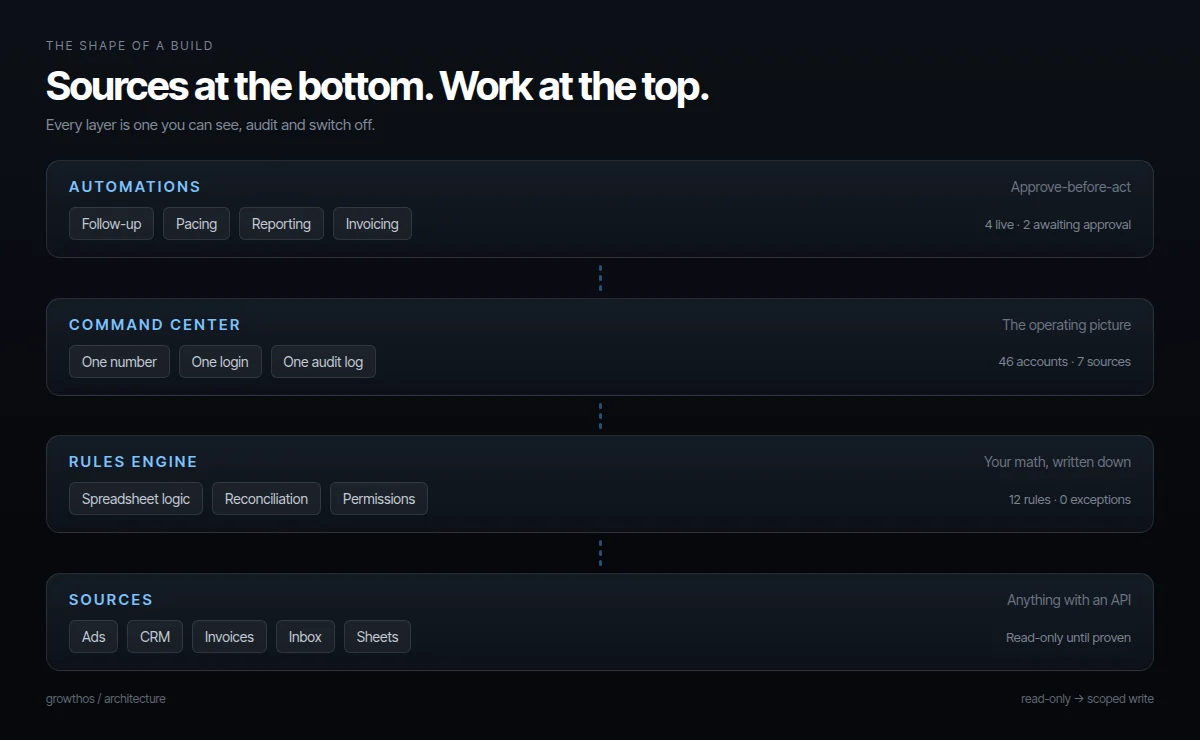
One zip · 43 files · Python 3 + SQLite
No mystery box
This is the real app — not a PDF, not a checklist, not a “framework” that lives in your head. It’s working software you install and run.
A web intake that puts every new lead into one pipeline the moment they arrive — no copy-paste, no lost message.
Every deal in one place with stages, owners and next steps, so nothing sits untouched for three days.
The work that has to happen, assigned and tracked, instead of living in your head.
The decisions that used to wait on you, routed to the right person with a paper trail.
The scoreboard that builds itself — leads, close rate, revenue per customer, churn — without a spreadsheet.
Follow-up, onboarding and win-back sequences that fire on schedule, not on memory.
A single view of what’s running and what’s quietly failing, before it costs you a customer.
One documented command to install, then plain-language guides to make it yours. No development project required.
The only requirements: Python 3.10 or newer, and SQLite — which is already bundled with Python. No cloud account, no vendor lock-in, no monthly bill.
The app, screen by screen
This isn’t a dashboard you check. It’s the eight screens a business actually runs on — each one replacing a thing you currently do by hand, or hold in your head.
The first screen you see is the one that used to take six tabs and a Monday morning to assemble: pipeline value, booked revenue, win rate, what needs attention, the 30-day trend, recent leads, tasks due, and whether your automations are running.
You stop: logging into five tools to learn what’s happening. The scoreboard builds itself, so your first question every morning is answered before you finish your coffee.
Every lead from every source lands in one searchable table. Filter by stage and source, open any lead to see its full activity timeline, notes, and exactly where it sits in the pipeline.
You stop: losing the “never got a reply” leads. The 60-second response becomes the default, and anything left untouched for three days gets flagged — not by you, by the system.
A kanban board by stage, with value and owner on every card. One look tells you where every dollar in your pipeline sits, who owns it, and what’s stuck.
You stop: guessing what’s actually closing. The board shows you — and the gap between “looks busy” and “is actually closing” disappears.
A checklist of open and completed work, with due dates, priorities, and every task tied back to a lead. What has to happen, who owns it, by when.
You stop: being the reminder system. The list remembers, so a task that matters can’t be forgotten the moment you get pulled into something else.
A human gate for the decisions that should still need a person — discounts, contracts, spend. Approve or reject with a note, and the trail is kept.
You stop: being the interruption. Your team gets answers faster, and you get the paper trail — not the 11 p.m. “can you just approve this?” text.
Weekly operating reviews generated from live data — print- or PDF-ready, with the numbers that actually matter. The review you used to assemble by hand, on demand.
You stop: spending Monday assembling a report. It assembles itself, so the review becomes “what did we decide” — not “what happened.”
Stale-lead follow-up, missing-next-step nudges, high-value review flags, and a weekly digest — each one you can toggle on or off, with a run history so you can watch it working.
You stop: the “I should have followed up” guilt. The system sends the day-2, day-5, and day-9 follow-ups, and you get the “it handled itself” feeling instead.
One screen for the things that quietly break — database, schema, disk, session secret, config, backups, and install metadata. Your business software, fully visible.
You stop: finding out about a problem after it costs you a customer. Because it’s self-hosted, the health of your system is yours to see — not a vendor’s to hide.
I’ve worked with thousands of businesses — service companies, agencies, clinics, multi-location operators, software and e-commerce brands. These are the five failures I can diagnose in the first ten minutes. Most businesses have all five.
Everything routes through you: approvals, answers, “quick questions.” Every task that needs your brain to move is a task that stops when you do.
A CRM, an email tool, a scheduler, a form builder — every tool does its job, none of them share a brain. The real integration layer is a human, copying and pasting.
Revenue rarely disappears at the sale — it disappears at the handoffs. Every handoff that depends on someone remembering will eventually be forgotten.
If answering “how many leads came in this week?” takes three logins and a guess, you’re steering by feel.
Your data, workflows and logic live inside platforms you don’t control. One price hike, one shutdown — and your “system” walks out the door.
One honest question: how many of the five did you just recognize in your own business?
The OS downloads free — and it’s built to fix every one of them.
Where this system comes from
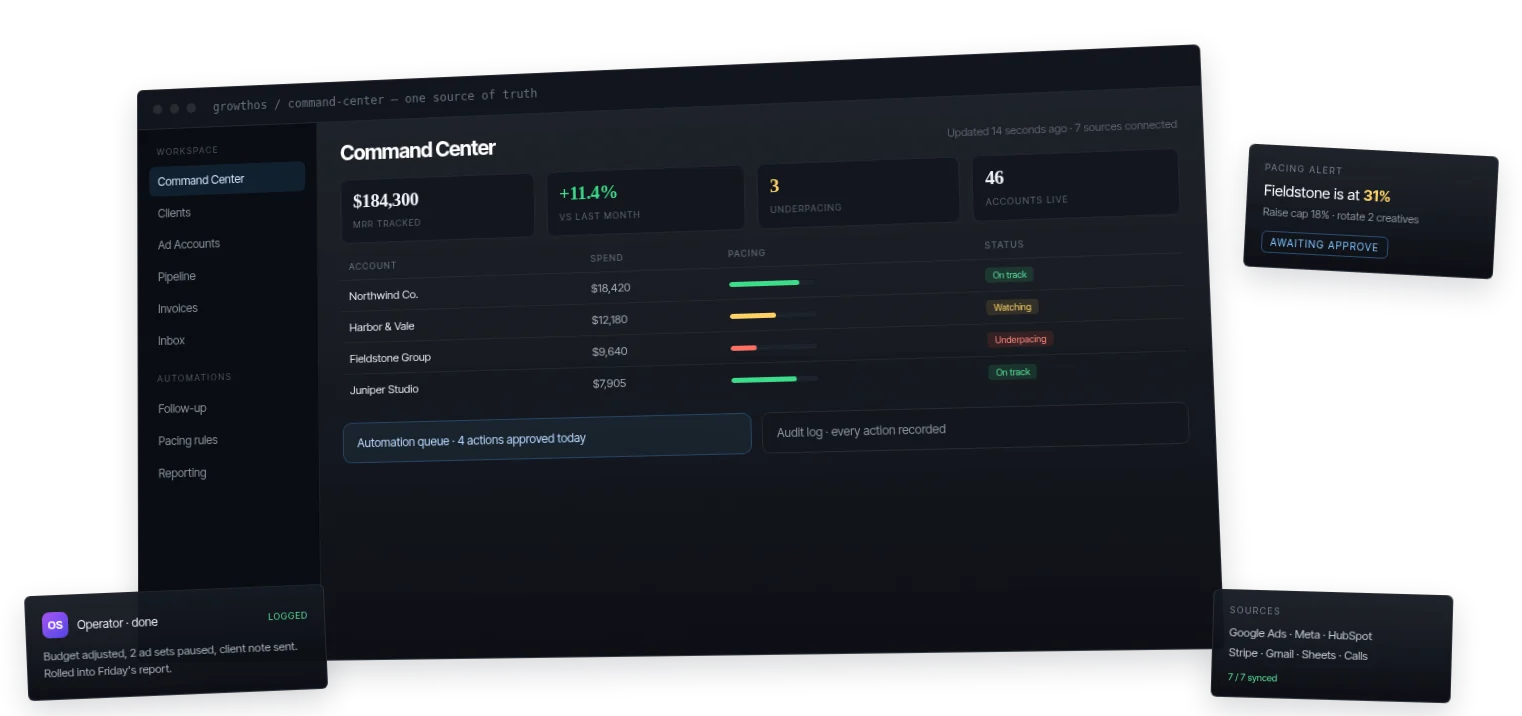
No borrowed screenshots, no invented reviews. This is the build the system comes from: an agency running 46 client Google Ads accounts, all of it on spreadsheets, moved onto one operating system.
A stack of spreadsheets
The source of truth was copy-paste, and the weekly reporting ran on memory.
46 accounts · 7 sources
Seven data feeds into one workspace — accounts, spend, budgets, client notes, calls and reporting in one place.
0 Monday exports
The report assembles itself, and pacing problems that used to be found by hand get flagged by the system.
One documented build, described from the work itself. It is not a testimonial and not a promise of results.
The question everyone asks
Fair question. A custom build of this system runs into the thousands and takes weeks. So why would I hand you the whole thing for $0?
Three reasons, all of them honest:
There is no upsell required to download. Put in your email, get the zip, run the install. That’s the whole deal.
THE STORY BEHIND THE SYSTEM
Let me tell you something I wish someone had told me fifteen years ago.
I spent my career running performance marketing for companies that spend more on ads in a month than most businesses make in a year — seven-figure monthly budgets across Google, Meta, YouTube and LinkedIn. And here’s what I learned watching those accounts up close: the companies that win don’t have better ads. They have better systems.
The ad is the last 1%. The other 99% is what happens after the click — who replies, how fast, what they say, where the lead goes, who follows up on day 2, who follows up on day 5, what the scoreboard says, and whether any of it happens without the owner standing over it.
That 99% is the operating system. And for years, nobody gave it to you.
You can name the tools: the CRM, the scheduler, the email platform, the chat widget, the form builder, the automation tool. You bought them because each one promised to fix a specific problem. And each one did — for its one little silo.
But nobody sold you the thing that connects them. Nobody sold you the rules. Nobody sold you the place where “what happens to a lead” is written down once and then just happens.
So you became the connector. You became the rules. You became the place where the answers live — and that’s why the business can’t run a single day without you.
Forget the jargon for a second. Here’s what a business looks like when it has an operating system:
A lead comes in at 11:14 p.m. on a Tuesday. The system opens a record, assigns an owner, and sends the first reply — before you wake up. It schedules the follow-ups on day 2, day 5, day 9. It flags the lead if nobody’s touched it in three days. When the deal closes, it kicks off onboarding automatically. When the customer hits 60 days, it asks for the review. When the scoreboard needs updating, it updates itself.
You didn’t do any of that. You designed it once, and it ran. That’s the difference between a job you own and an asset you own.
Right now you can ask an AI chatbot to “automate my business,” and it will happily generate a pile of disconnected scripts and tasks. That’s a worker with no system to plug into — faster chaos.
I run custom AI agents for companies spending seven figures a month, and I’ll tell you the part nobody advertises: an AI agent is only as good as the system it’s wired into. Give it a real operating system — a pipeline, rules, a source of truth — and it becomes the employee that never sleeps. Give it a pile of apps and it becomes another thing to babysit.
The operating system comes first. The agents plug into it. That’s the order. And the operating system is the part you can download right now.
Good — you shouldn’t have to be. Installing this is one documented command. The app is Python and SQLite, which means it runs on a $6 server or an old laptop, and you own every byte. The “technical” part of a business OS was never the code. It’s the design — and the design is just decisions, written down.
Some of you did everything right. You bought the software, connected the apps, added the automations. And the business still depends on you. Here’s why: tools are not architecture. Adding more rooms to a house with no blueprint makes the house harder to navigate, not easier.
The fix is almost never “one more tool.” It’s structural. And it’s findable — which is exactly what the download gives you a working example of.
Every subscription you rent is a monthly bill that can change, break, or disappear. Your customer data, your workflows, your logic — all of it living on rented ground.
This system is the opposite. It runs on your server. The data is yours. The rules are yours. The code is yours. Rent the commodity. Own the core. That’s the whole philosophy, and the download is it, in working form.
You’ll run one command, and the system will be live on your server. Then the real question stops being “what tool should I buy” and becomes “where do I start mapping this to my business”.
If you want to do that yourself, everything you need is in the guide. If you want a hand, there’s a live two-hour workshop where I walk you through fitting it to your business — but you don’t need it to download, install, and start using the system today.
Your move. The download’s right there.
Click any button on this page. A short form opens — your name and email, nothing else.
Your download link appears instantly, and a copy lands in your inbox.
One command in the guide, and the whole system is live on your server. Yours to keep.
No credit card · no trial · no expiration
Yes. You enter your email, you get the download — the full 43-file system, nothing held back. No credit card, no trial, no expiration.
Python 3.10 or newer and SQLite (which is bundled with Python). It runs on Ubuntu, Debian, or a Mac — a small server or even an old laptop works fine.
No. Installing is one documented command. Customizing — the pipeline, the rules, the automations — is done through the interface and plain-language guides.
Yes. It runs on your server and stores everything in your own SQLite database. No vendor holds your data, and no subscription can take it away.
No catch. Some people download it, build with it, and that’s it. Others decide they’d rather have a hand fitting it to their business — and there’s an optional live workshop for that. The download itself is free and stays free.
Every business has the same five jobs — Capture, Convert, Deliver, Retain, Command. The details change; the architecture doesn’t. Service businesses, agencies, clinics, e-commerce, SaaS, and multi-location operators all run this framework.
The install and customize guides walk through the common paths. The optional live workshop is where I answer questions directly — but you don’t need it to get started.
The next quarter in your business will go one of two ways: more tabs, more tools, more late nights in the inbox — or a system that quietly does the routing, reminding and tracking while you do the work only you can do.
The system exists. It’s built. It’s 43 files, it’s free, and it’s one click away.
Free · 43 files · self-hosted · yours to keep
Built, Not Rented.
— Mikee
Free download
43 files · Python 3 + SQLite · yours to keep. Enter your email and the download link is yours.
One quick question
So we know where it hurts most right now.
You’re in
The zip is yours, right now. Download it to your machine and run the install — it’s yours to keep.
Download CustomGrowthOS ↓ Continue to the next step →Hmm — that didn’t go through
Something went wrong saving your details. Please try once more.